Prescription fertiliser pushes clover production ‘through the roof’
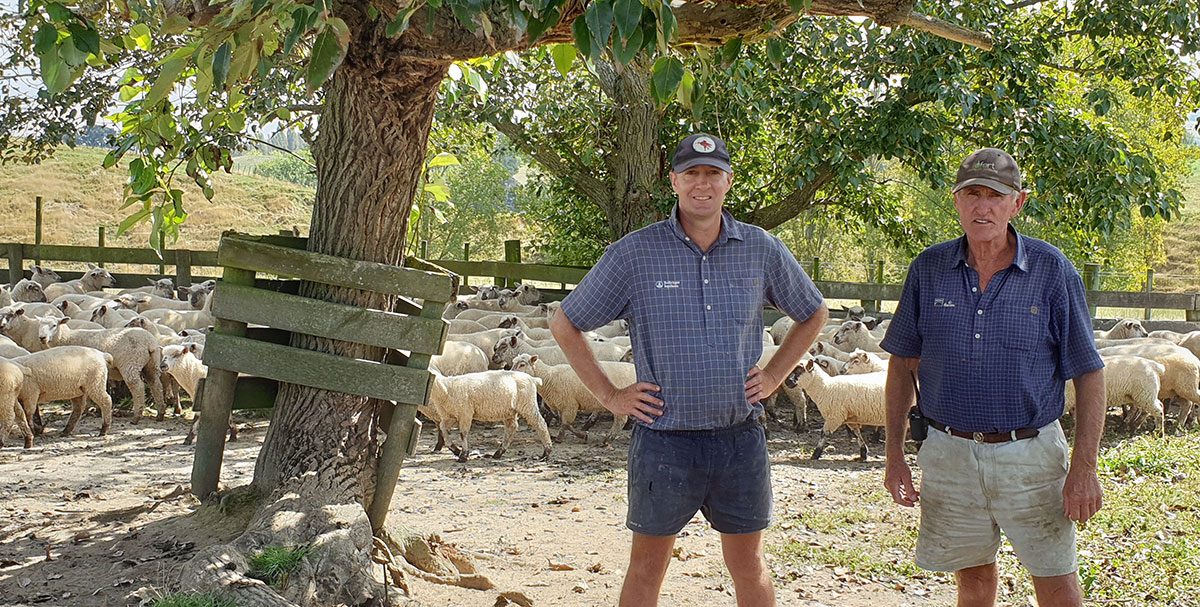
John & Simon Foster, Hautope Land Co, Hawke’s Bay — Sheep & Beef
1,170ha
hawke’s bay hill country
10,000
lambs wintered
15+yrs
working with i-fert
8→72
earthworms per spade square
“It used to be all about the grass but working with Corey has shown me it’s actually all about the soil,” said Hawke’s Bay farmer John Foster. John works alongside his son, Simon, over-wintering ten thousand lambs, 400 breeding cows, 100 two-year heifers and 100 one-year heifers on 1,170ha of rolling to steep Hawke’s Bay hill country about 20 kilometres from the coast. The main farm is split into two blocks — with the upper block mainly steep and the lower block rolling to easy. Two years ago they leased an additional 130ha block from a neighbouring farm.
John has been working with i-Fert’s Corey Martin for over fifteen years and credits the changes he’s seen in pasture diversity and quality to Corey’s advice and prescription fertiliser treatments over the years.
“Initially our soil structure was poor with few earthworms and not much clover — it’s not free-draining soil, so compaction and thatch problems just made it worse. When we started, Corey dug a square spade of soil and counted eight earthworms. We test on that spot every year and at last count there were 72.”
John wanted to move away from superphosphate, so his initial change was to fine particle lime to ‘sweeten up the soil and get the earthworms working’. Corey tested and analysed the soil and identified which nutrients and trace elements were missing, and they set about correcting things.
The soil across the farm has a low anion storage capacity (13%), reducing its capacity to hold on to negatively charged nutrients like nitrogen, sulphate and phosphate — so Corey focused on sustained release treatments. The farm was treated in two blocks, alternating applications of iPrills containing lime, sulphur, trace elements and the biostimulant organoplex, year on year, with the exception of one whole-farm treatment in 2015. As the soil structure, respiration rate and earthworm numbers improved, the treatment changed to an annual application of iPhos.
According to Simon Foster, it’s easy to see the physical response to Corey’s fertiliser regime across the farm.
“When Corey first got involved, there was a lot of thatch stopping nutrients and moisture getting through to the grass roots. The organic matter gets broken down much more quickly now. We’ve got clovers everywhere — red, white and sub — even on the south-facing slopes.”
Stock grazing patterns have changed as well, with the animals feeding on every part of the paddock, no rank grass and hardly any brown to be seen across the farm.
“We’ve got cleaner, healthier stock too. We used to spend a lot of time dagging at lambing and now we don’t do much at all.”
When they leased the additional 130ha, Simon asked Corey to carry out soil testing so they could bring the new block up to full production as soon as possible. Five treatments have been applied to date to push pasture condition and clover — and the land has come on in leaps and bounds. Resin P levels have moved from 48 to 85 and Olsen P levels from 19 to 28.
“When we looked at the grass roots, they went down a couple of inches and then went horizontal — searching for nutrients. We’ve recently taken another look and the roots go straight down, much deeper — aerating the soil and pushing nitrogen from the clover further into the soil.”
“Corey has shown us that important nutrients walk off the farm with the stock — so we need to keep replacing them. Clover production is through the roof, we’ve got more diversity in the pasture and it’s more palatable — the animals are looking great. We’re really happy with the way the farm’s going.”

Clover production is through the roof, we’ve got more diversity in the pasture and it’s more palatable — the animals are looking great.
John & Simon Foster, Hautope Land Co
Get in Touch