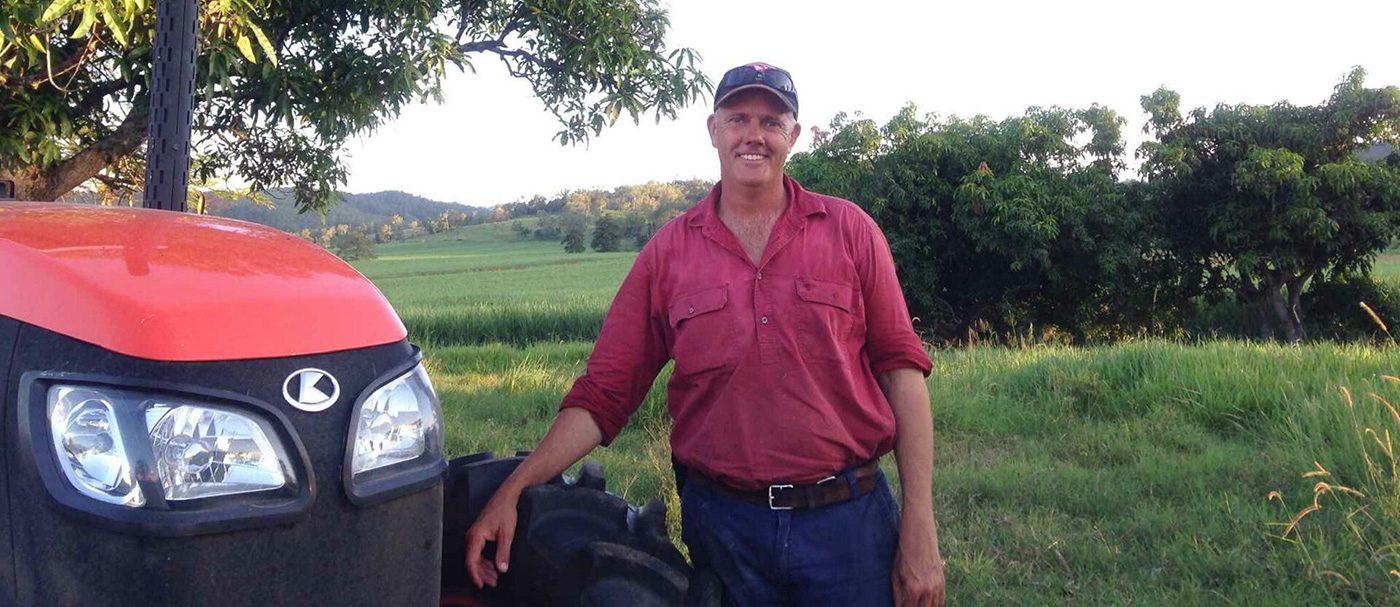
Poor yields reversed on Queensland sugar cane operation
Scott McLean, Mackay, Queensland — Sugar Cane
200ha
sugar cane farm, mackay
+10%
yield increase
+15%
sugar content (PRS) gain
$400/ha
extra return vs. conventional
Scott is the fourth generation of the McLean family to run the 200ha sugar cane farm in Mackay, Queensland. The farm is well-managed with a history of good yields, but Scott found himself facing increased pest and disease pressure and low yields — down from a 100T/ha peak in the 1980s to 80T/ha or less. This was having a major financial impact on the operation.
“We were going from disease to disease, trying new treatments — spraying, inoculating. Nothing was doing much good. Yields were down, so we were putting on more fertiliser but still getting less production. The cane wasn’t even responding to irrigation.”
Despite input changes and support from local agronomists, Scott was unable to address the decline until a New Zealand pilot, employed by the family aerial spraying business, suggested he talk to Kiwi soil and plant nutritionist Corey Martin from i-Fert. After some discussion, Scott persuaded Corey to come over to Queensland to take a look at the farm for himself.
Corey quickly identified reasons for the issues the farm was facing: very low soil pH, high aluminium toxicity, and deficiencies in minerals like phosphorous, sulphur, boron, zinc and silica. Many of the deficiencies were significant enough for Corey to identify in the field. All his observations were backed up by thorough soil and herbage analysis.
“Corey was very logical and could prove what he was saying scientifically through testing in the field. He explained why we were having the problems we’d been having and it all made sense. So we decided to put his recommendations into practice.”
Corey then set about adapting his knowledge and technology to Queensland conditions, where a crop can go from drowning to drought in the space of a month. Scott and Corey started a staggered trial, always leaving a conventionally treated area to act as a control. The trials were carefully positioned on square blocks of land of a consistent soil type and with irrigation across the whole block — ensuring that the only variable was the fertiliser treatment applied.
The first year, five hectares were treated with Corey’s prescription of fertiliser, micronutrients and biostimulants. The second year, 30 hectares received the i-Fert treatment; the third year, 60 hectares. This year, i-Fert has treated all but a 40 hectare fallow block on Scott’s farm.
“It’s no longer a trial. It’s a proven, successful approach with consistent results. We’re at a stage where the gains we’ve made in yield and sugar content mean that I can’t afford not to treat most of the crop.”
The results speak for themselves. Over the last four years yield has improved by an average of 10% and the PRS by 15% — and it’s still getting better. The i-Fert-treated crops scored an average 15 PRS and 82T/ha yield, compared with 14 PRS and 70T/ha from blocks treated with conventional fertiliser — earning Scott roughly $400/ha more on the i-Fert blocks.
Soil respiration is a reliable indicator of soil health — a good average for healthy soil is 3,500. The baseline figure on Scott’s farm was 700 before the first i-Fert treatment. It’s now between 4,500 and 5,000, and continuing to improve.
“This year it’s been a really difficult season. We’ve gone from December floods to January drought and we’ve still been able to maintain our yields — which means the i-Fert treatment is paying for itself. By investing in the health of our soil, we’re building strong foundations for seasons to come. I’m getting a 10% return from i-Fert and only 4% with the bank — I know where I’m putting my money.”

I’m getting a 10% return from i-Fert and only 4% with the bank — I know where I’m putting my money.
Scott McLean, Mackay
Get in Touch